Fractional CTO vs Full-Time CTO: Cost, Scope & When Each Makes Sense
Almost every founder I talk to frames this decision the same way. They look at the price of a full-time CTO, look at the price of a fractional one, and try to figure out which one they can afford.
That is the wrong starting point.
The price gap is real, but it is not the thing that should drive the decision. The thing that should drive the decision is what your company actually needs right now — and how long that need will last.
I have been on both sides of this. I have been a full-time CTO. I have done fractional engagements with companies that should have hired full-time, and with companies that would have wasted a year of runway if they had. Here is how I think about it.
What Each Role Actually Is
Before comparing them, it helps to be clear about what they are.
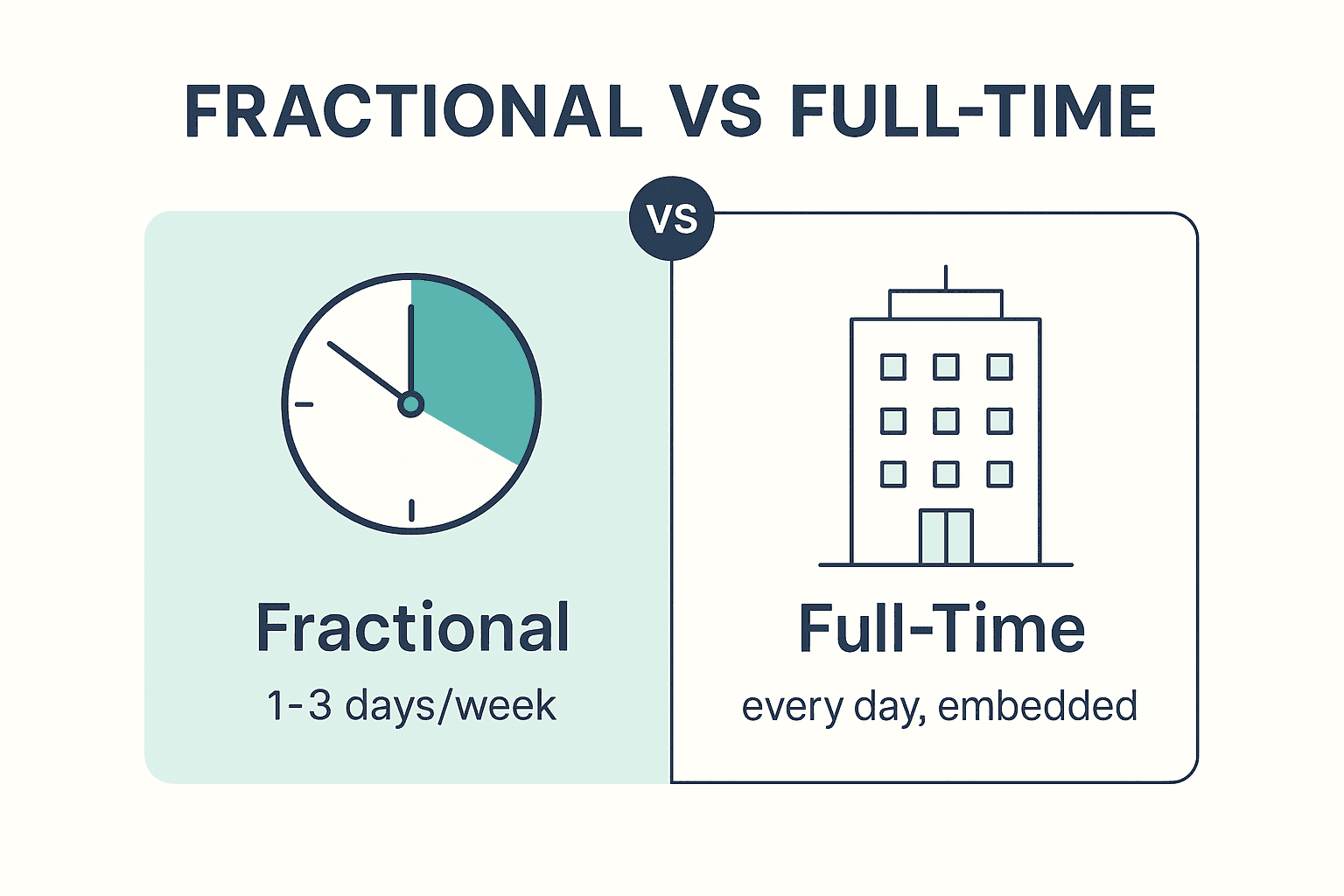
A full-time CTO is an executive who owns the technical side of the company end-to-end. They sit on the leadership team, build and run engineering, own the roadmap, hire the people, and live with the long-term consequences of every decision. They are fully embedded. They are also fully committed — you cannot easily swap them out, and they cannot easily walk away.
A fractional CTO is an experienced technical executive who works with you part-time, on a contract basis. One to three days a week is normal. They bring the same kind of senior judgment a full-time CTO would, but applied in a more focused way and for a defined window of time.
Both roles can be valuable. They solve different problems.
The Real Cost Comparison
Let's get the numbers out of the way, because most founders ask about them first.
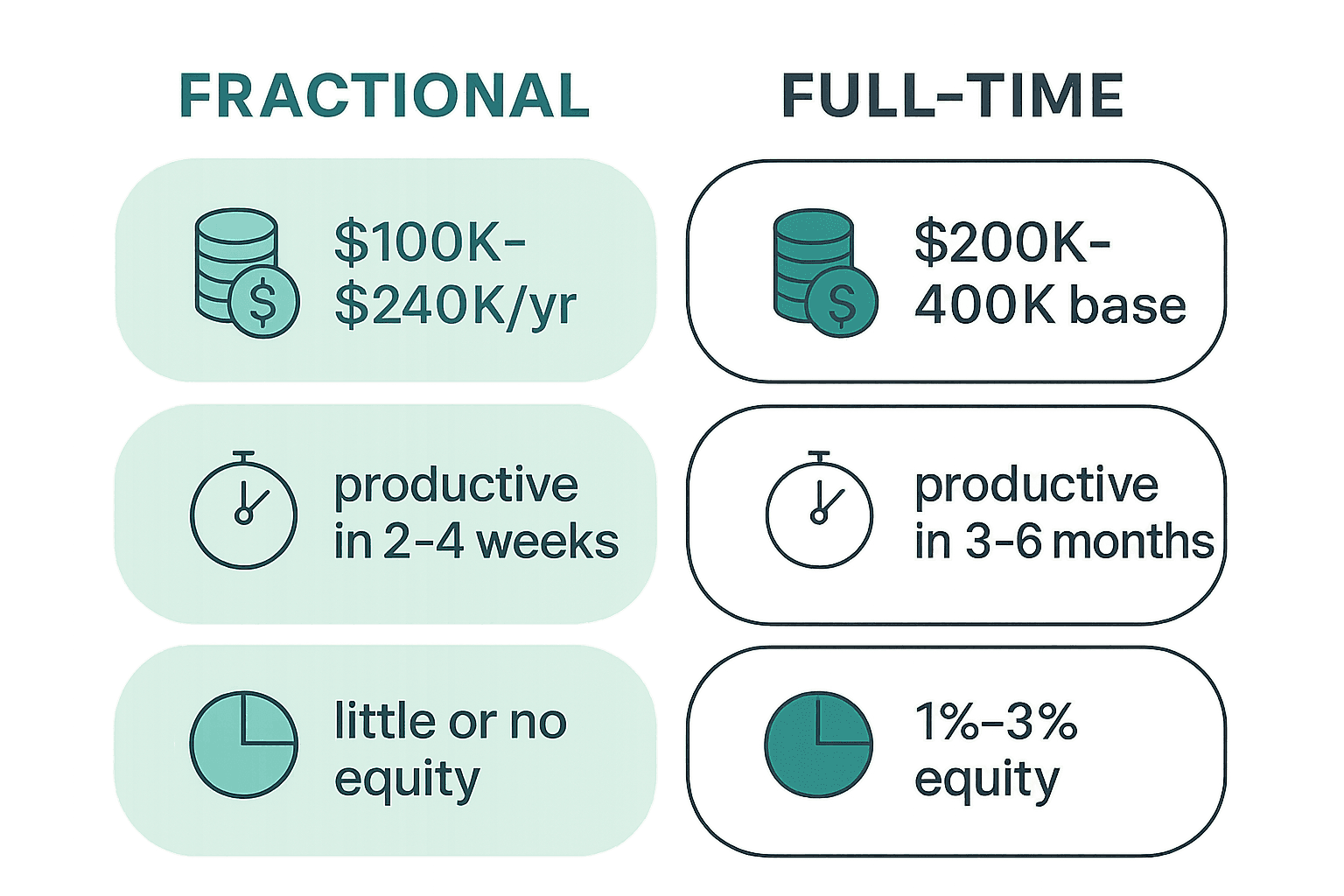
A full-time CTO in North America or Western Europe in 2026 will cost you somewhere between $200,000 and $400,000 in base salary. Add benefits, bonus, and equity (usually 1% to 3%), and the all-in cost is closer to $350,000 to $550,000 per year. That is before you count the ramp time — three to six months before they are fully productive — and the cost of a wrong hire, which is often six figures of wasted runway.
A fractional CTO in the same market runs $8,000 to $40,000 per month, depending on time commitment. Most engagements land in the $8,000 to $20,000 range, which works out to roughly $100,000 to $240,000 per year. No equity, in most cases, or a small advisory grant. No multi-year commitment. Productive in two to four weeks.
| Fractional CTO | Full-Time CTO | |
|---|---|---|
| Annual cash cost | $100K–$240K | $200K–$400K |
| Equity | None or small advisory grant | 1%–3% |
| Time to productive | 2–4 weeks | 3–6 months |
| Commitment | Month-to-month or short contract | Multi-year |
| Time per week | 8 to 24 hours | Full time |
| Cost of being wrong | Low — short contract | High — months to unwind |
The cost difference is significant. But again — it is not the main story.
The Real Question: Scope
The right question is not "which is cheaper." The right question is what do I actually need this person to do.
A full-time CTO is the right shape when the role demands continuous presence. Daily decisions. Constant context. Living and breathing the product and the team. They are owning the long-term outcome.
A fractional CTO is the right shape when the role is about applied judgment, not constant presence. Strategic calls. Senior hires. Architecture choices. Investor conversations. The kind of work where five focused hours from someone with twenty years of experience is worth more than forty hours from someone learning on the job.
A useful test: if you wrote down everything you need the CTO to do this month, would most of it require them to be in the building every day? If yes, you probably need full-time. If most of the work is a small number of high-stakes decisions, you probably need fractional.
When Full-Time Is the Right Answer
There are clear patterns where full-time is the right call.
You have product-market fit and are scaling fast. Past 30 to 40 engineers, the role demands more continuity than a fractional engagement can give you. There are simply too many decisions, too many people, and too much context for a part-time presence to keep up.
Engineering is your core competitive advantage. If your product is, at its heart, a technical product — a database, a developer tool, deep ML infrastructure, anything where the engineering itself is the moat — you need a full-time technical executive shaping every layer of it.
You are at Series B or later. By this stage, investors, customers, and the board all expect a permanent CTO. A fractional arrangement starts to feel like a gap, not a strategy. It also becomes hard for one person to hold all the context part-time once the company gets large enough.
You are about to enter a multi-year technical bet. Major rewrites, new platforms, big infrastructure shifts. These are long arcs of work where continuity matters more than anything else. A fractional CTO can shape the strategy, but the day-to-day execution needs someone whose entire focus is the bet.
If you are in one of these situations, do not try to save money with a fractional. You will end up paying more in the long run.
When Fractional Is the Right Answer
There are equally clear patterns where fractional is the right call.
You are pre-Series A and still figuring out the product. At this stage, you do not yet know what you need from a CTO. Hiring full-time is committing to a job description you cannot yet write. A fractional engagement helps you do the work and learn what the full-time role should eventually look like.
You have a strong tech lead but no executive. This is one of the most common patterns I see. Your most senior engineer is great at code and architecture, but is not ready for board meetings, hiring at scale, and cross-functional leadership. A fractional CTO partners with them — handles the executive layer, mentors them into it, and makes the eventual handoff smoother.
You are between CTOs. Your CTO leaves. The search will take six to nine months. In the meantime, the team has no senior leadership and decisions stall. A fractional CTO stabilises the team, keeps the work moving, and protects the search from turning into a panic hire.
You need an outside voice. Sometimes the problem is not capability. It is politics, blind spots, or founder history. A fractional CTO can say "this is wrong" without their job depending on the answer. That independence is hard to get from anyone whose career is fully attached to your outcome.
You are doing technical due diligence. Pre-acquisition, pre-investment, or pre-partnership. You need a credible technical voice in the room for a defined window. A fractional CTO with M&A experience can handle this in weeks.
The Hidden Cost of Hiring Full-Time Too Early
The most expensive mistake I see early-stage founders make is hiring a full-time CTO before they know what they need that person to do.
Here is what that mistake usually looks like.
You raise a seed round. You feel pressure — from investors, from peers, from your own list of things to do — to "hire a CTO." You find someone impressive. You offer $300,000 and 2% equity. They take it.
Six months in, it is not working. The CTO is sitting in meetings that did not need to exist. The engineering team is small enough that they did not need a layer of leadership above the tech lead. The CTO is not happy with the level of strategic work. You are not happy with the burn rate. The relationship gets tense.
Now you have to unwind it. That conversation is hard. The equity is messy. The team is unsettled. You have lost six to twelve months and several hundred thousand dollars of runway. Even worse — you still do not have a CTO, and now you are gun-shy about hiring one.
A fractional engagement at the same stage would have cost a fraction of that, taught you what the role should actually look like, and left you in a much better position to make a permanent hire when the time was right.
The Hidden Cost of Staying Fractional Too Long
The opposite mistake exists too, and it is just as expensive.
A fractional engagement works well. The founder gets used to it. The company keeps growing. At some point the team is forty engineers, the company is post-Series B, and the founder is still trying to run engineering with a fractional CTO two days a week.
This does not work. There is too much context, too many people, too many in-the-moment decisions. The fractional CTO is stretched thin. The team feels the absence on the other three days. Important things start to slip — not because anyone is doing a bad job, but because the shape of the role no longer fits the shape of the company.
A good fractional CTO will tell you when this is happening. The signal is usually three or four months of "we really need to talk about hiring a full-time person." When you hear that, take it seriously. The fractional model has an expiry date. Knowing when to graduate from it is part of getting the most value from it.
How to Decide
If you are trying to choose between the two right now, here is a simple way to think about it.
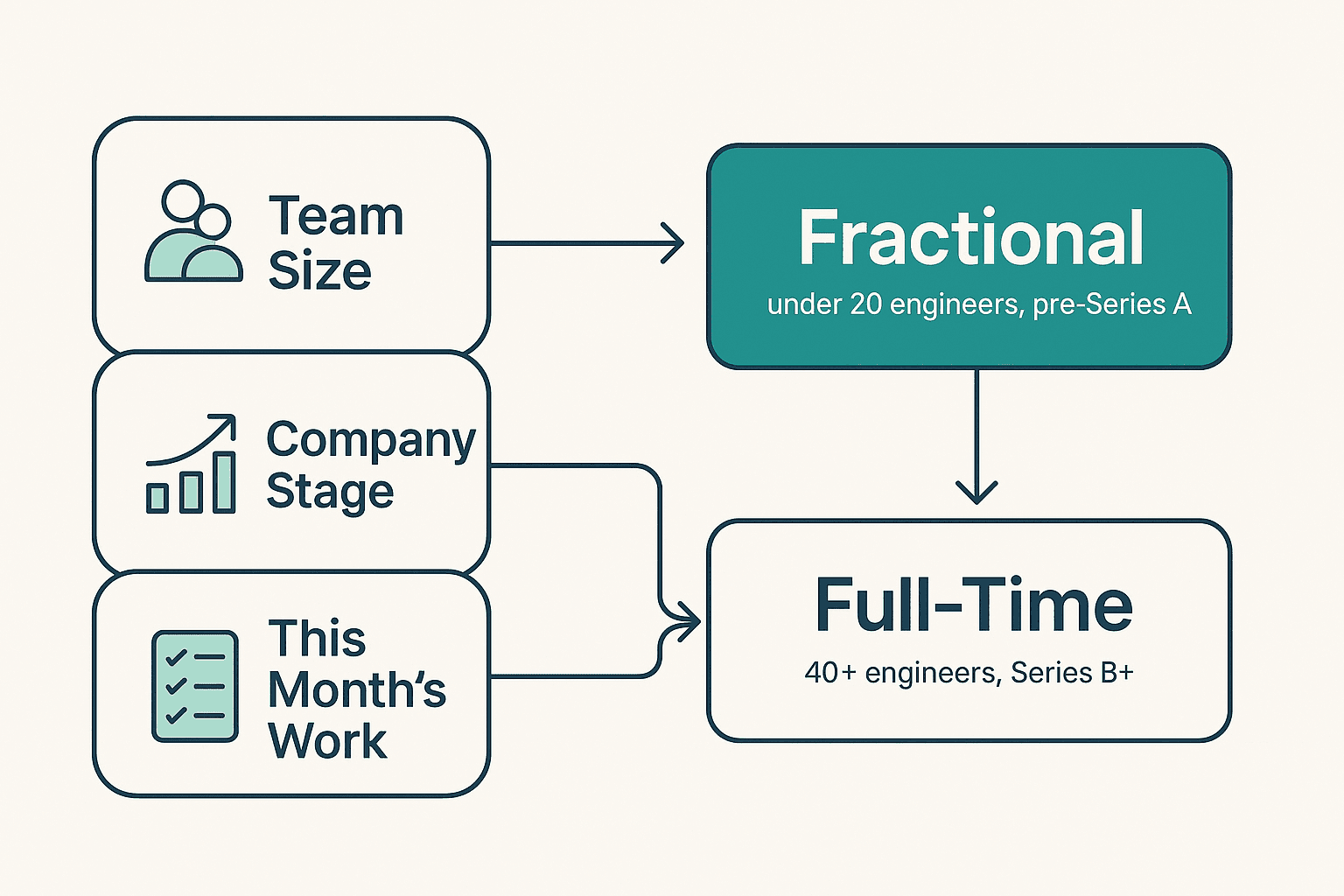
Start with these three questions:
- How big is your engineering team today, and how big will it be in twelve months? Under twenty engineers — fractional is usually fine. Twenty to forty — it depends. Past forty — you almost certainly need full-time.
- What stage are you at? Pre-PMF or pre-Series A — fractional. Series A in flux — could go either way. Series B and beyond — full-time.
- What do you actually need the CTO to do this month? If the list is mostly meetings and presence, full-time. If the list is a few high-stakes decisions and some hiring, fractional.
If those three answers point in the same direction, you have your answer. If they conflict, the safer move is usually to start fractional. It is much easier to convert a fractional engagement into a full-time hire — sometimes with the same person, sometimes not — than it is to unwind a full-time CTO that was hired too early.
A Final Note
There is no badge of honor for having a full-time CTO. There is no shame in working with a fractional one. Some of the strongest engineering teams I know spent years with fractional leadership and only hired full-time when the company genuinely demanded it. Some of the most painful engineering messes I have walked into came from companies that hired full-time too early, picked the wrong person, and spent two years recovering.
The question is not which role sounds more impressive. The question is what your company needs right now. Pick the shape that fits the need. Change it when the need changes.
If you want to talk through which one fits your situation, I'm happy to have that conversation. And if you are still earlier in the journey, What is a Fractional CTO? and When Does Your Startup Need a CTO? are good places to start.
Hit like if you enjoyed this post!
Keep reading
Your First 90 Days as a Fractional CTO: A Practical Playbook
The first 90 days set the tone for the entire engagement. Move too fast and the team resists. Move too slow and you lose credibility. Here is the playbook I follow.
May 25, 2026Fractional CTOHow Much Does a Fractional CTO Cost in 2026?
Fractional CTO pricing is all over the place. Here are the real numbers, the engagement models, and what actually drives the price up or down.
May 25, 2026