How Much Does a Fractional CTO Cost in 2026?
This is one of the most common questions founders ask before they even reach out about an engagement. And it is fair — pricing for fractional CTO work is all over the place, and most articles online either dodge the question or give such a wide range that it is not useful.
Here is a more honest answer. Real numbers from real engagements in 2026. The ranges are still ranges — the price depends on real factors — but you should walk away from this article with a clear sense of what is normal, what is high, what is low, and what drives the difference.
The Short Answer
In 2026, a fractional CTO engagement in North America or Western Europe typically costs between $8,000 and $40,000 per month, depending on time commitment.
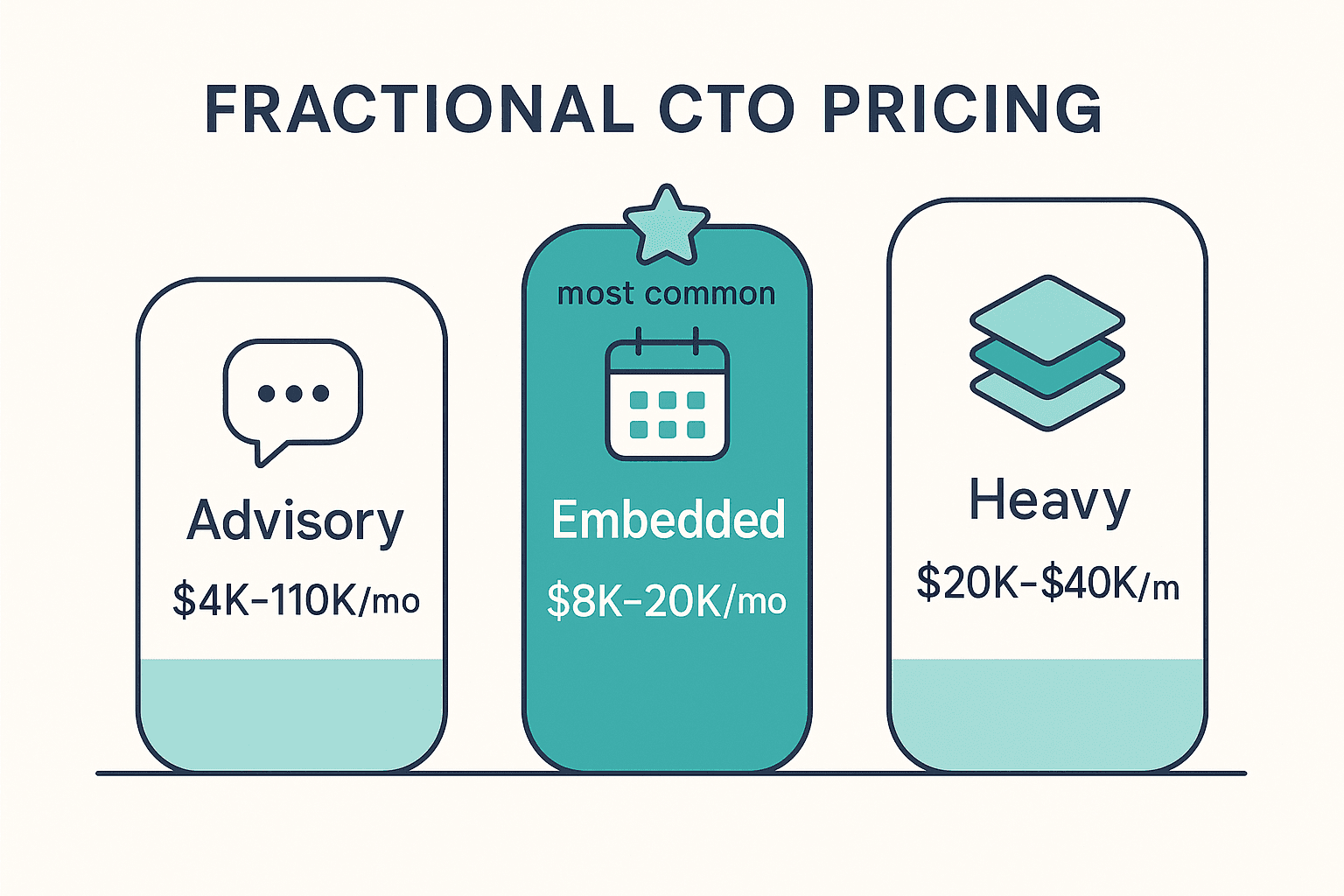
Most engagements land in one of three brackets:
- Advisory tier, 4 to 8 hours per week: $4,000 to $10,000 per month
- Embedded tier, 1 to 2 days per week: $8,000 to $20,000 per month
- Heavy tier, 3 or more days per week: $20,000 to $40,000 per month
The embedded tier is by far the most common. If you are budgeting and you don't yet know which tier you'll land in, plan for roughly $12,000 to $18,000 per month and adjust from there.
The Three Common Engagement Models
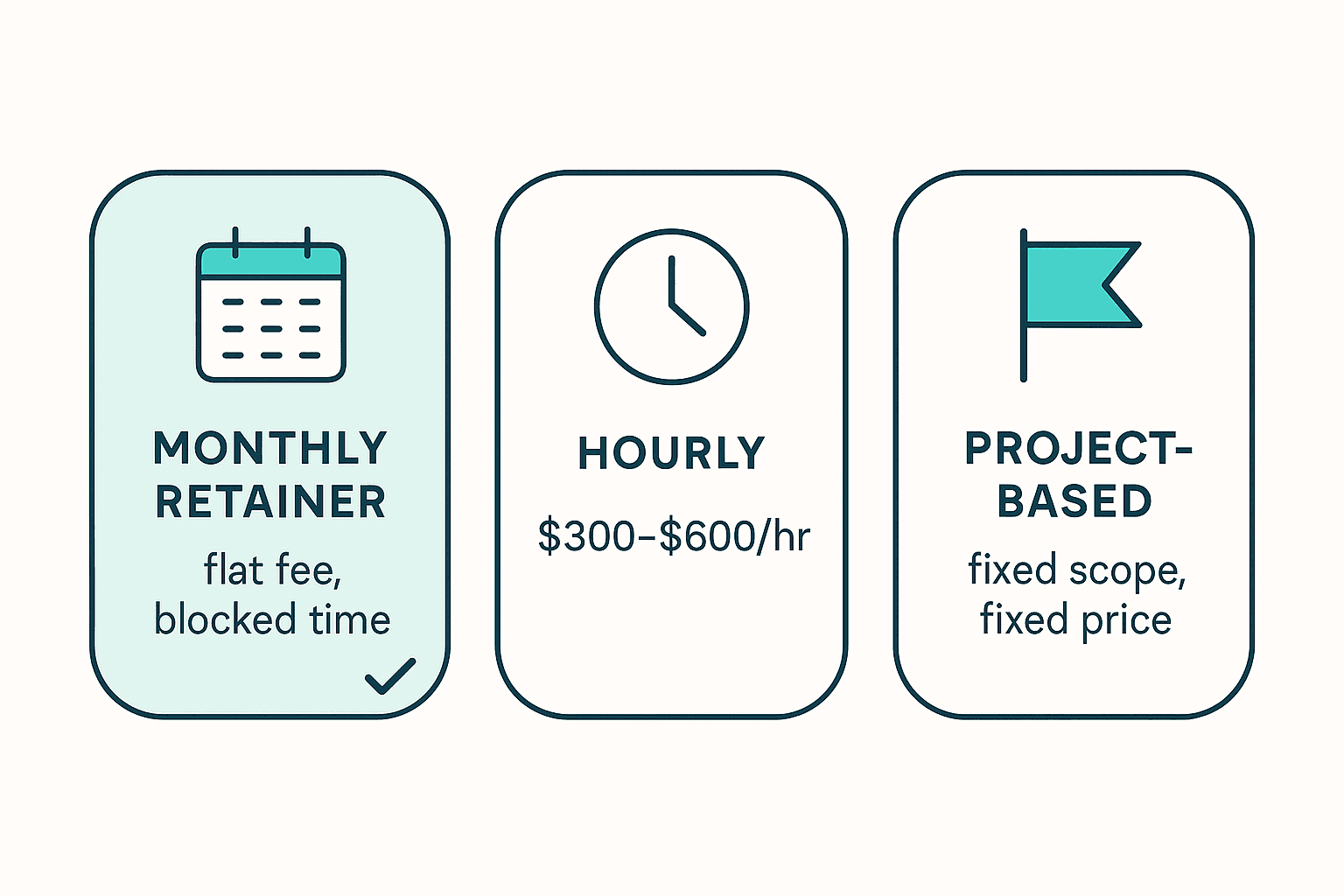
There are three ways fractional CTOs structure their pricing. Each one fits a different kind of relationship.
Monthly Retainer
The most common model. You agree on a set number of hours or days per week, and you pay a flat monthly fee. The fractional CTO blocks that time for you and is available within an agreed scope.
This is the cleanest arrangement for both sides. You know your monthly cost. They know their monthly revenue. The relationship has a steady cadence rather than a transactional feel.
Most monthly retainers run on 3 to 6 month minimum commitments, with 30-day notice after that. Some are pure month-to-month from day one.
Hourly
Less common at the senior end of the market, but still used — especially for advisory-tier engagements or when the work is genuinely lumpy.
Hourly rates for fractional CTO work in 2026 typically run $300 to $600 per hour. Some specialists charge more — $700 to $1,000 — usually when there's a specific domain expertise (regulated industries, M&A diligence, deep platform experience).
The downside of hourly is that it puts both sides in a slightly adversarial position. The CTO thinks twice about every additional minute. The founder thinks twice about every additional question. That is a bad dynamic for the kind of work fractional CTOs do well, which is judgment-based and hard to time-box.
I usually steer founders away from hourly for ongoing engagements. It is fine for short-burst work — a four-week tech audit, a board meeting prep — but for anything that should feel like a partnership, retainer is better.
Project-Based
A defined scope, a defined deliverable, a fixed price.
This works well for specific pieces of work: technical due diligence, architecture review, an interim CTO bridge between two full-time hires. The deliverable is clear, the timeline is clear, and the price is fixed.
Typical project prices in 2026:
- Technical due diligence for a startup: $15,000 to $40,000
- Architecture review: $10,000 to $30,000
- Engineering process audit: $8,000 to $20,000
- Interim CTO bridge (3 to 6 months): $60,000 to $150,000
Project-based is the right model when both sides can clearly define what "done" looks like. It is the wrong model for open-ended advisory work, where the scope inevitably shifts.
Equity: When It Comes Up and When It Shouldn't
A lot of early-stage founders try to substitute equity for cash. Sometimes this is appropriate. Often it is not.
The honest reality:
Small advisory grants (0.1% to 0.5%) on top of a cash retainer are common and usually fine. They align incentives, they make the fractional CTO feel like part of the company, and they don't create messy long-term complications.
Pure-equity engagements with no cash are almost always a bad deal for both sides. The fractional CTO is effectively working for free during the most expensive years of their career. The founder ends up with a part-time advisor who doesn't have enough at stake to do the hard work. These engagements rarely last six months.
Heavy equity grants (1% or more) to part-time advisors create long-term cap table problems. By the time you raise your Series B, you have a 1% holder who has been off the project for two years and who you barely talk to. That comes back to bite you in fundraising and exit conversations.
The cleanest arrangement is cash-based, with a small optional equity grant if both sides want it after the engagement has proven itself.
What Actually Drives the Price
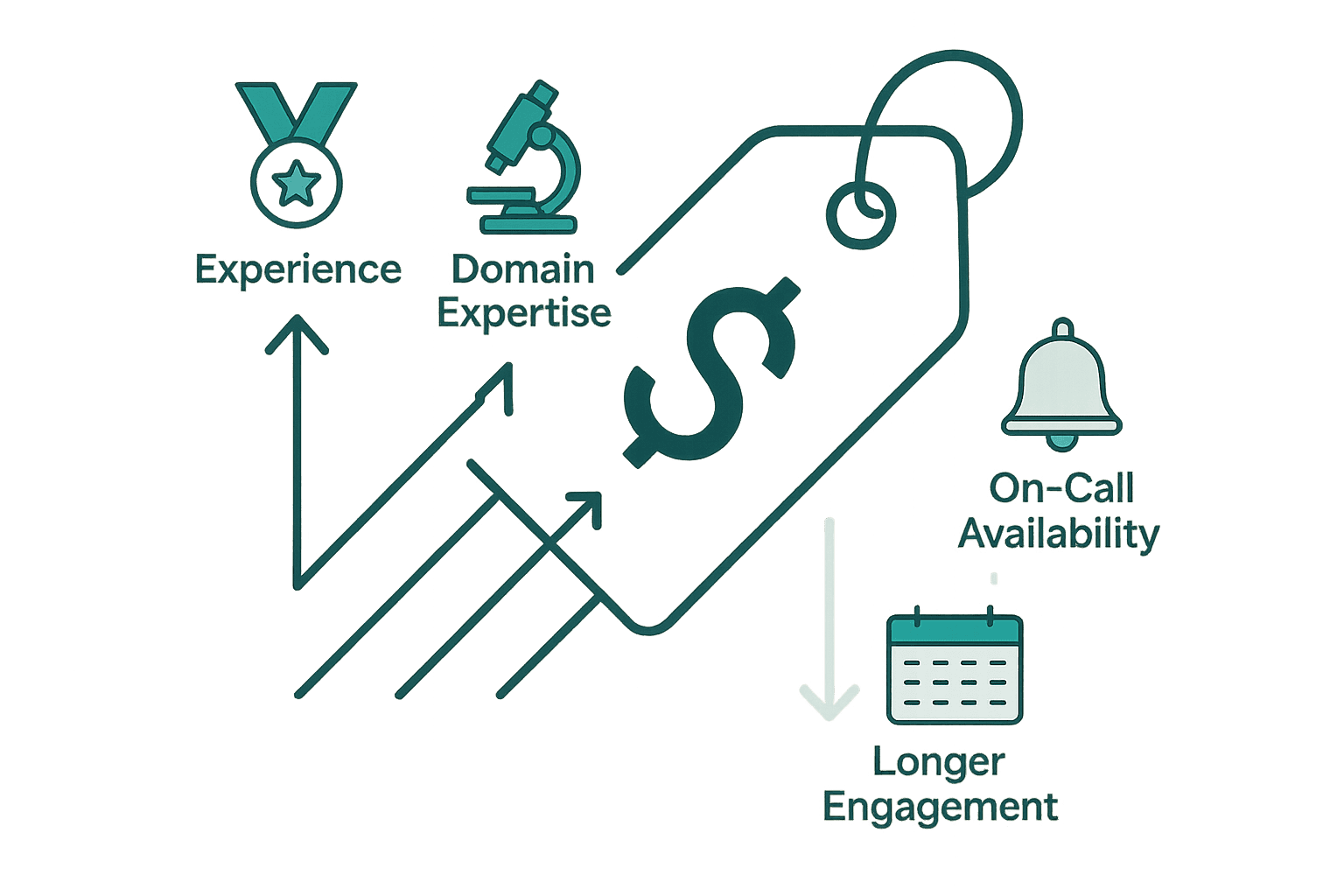
Within those ranges, several factors push the price up or down.
Experience Level
A fractional CTO with 5 years of senior leadership experience charges differently than one with 20 years. The 20-year person has lived through more cycles, made more mistakes, and seen more patterns. They cost more — sometimes 2 to 3 times more — and they are often worth it for the strategic work where pattern recognition matters most.
Stage Specialisation
Some fractional CTOs work mostly with pre-seed companies. Others work mostly with Series C and beyond. The two groups charge differently and operate differently. Stage match matters more than rate — a cheap fractional CTO who has never worked at your stage will cost more than they save.
Domain Expertise
If you need someone with specific industry expertise — fintech regulation, healthtech compliance, deep ML infrastructure, hardware — you pay a premium. That premium is usually worth it. Domain expertise compresses learning curves dramatically, and learning curves on a fractional engagement are expensive.
Geography
There is a real but shrinking geographic premium. A fractional CTO based in San Francisco or London tends to charge 20% to 40% more than one based in a smaller market. With remote work being the default, this gap is closing. Many of the best fractional CTOs I know are based in mid-cost cities and charge top-of-market rates because their value is decoupled from where they live.
Time Commitment Variability
Engagements that need genuine on-call availability — being reachable for urgent decisions, being available for unscheduled meetings — cost more than engagements with predictable, blocked time. This is true even when the total hours are the same. Reserving time has a real cost.
Length of Engagement
Longer engagements often have better rates than shorter ones. A 12-month engagement at a slight discount is usually a better deal for both sides than a series of 90-day engagements at full rate. The CTO gets stability and depth. You get someone who is genuinely invested in your outcome.
What You Are Actually Paying For
It is easy to look at $15,000 per month and think "that is a lot of money for two days a week." It is. But the question is not whether the hours are expensive. The question is whether the value of those hours is worth the cost.
What a good fractional CTO actually delivers in a month:
- One or two architecture or platform decisions that will shape the next 12 to 24 months of work, made with the benefit of having seen similar decisions play out at other companies.
- Senior hiring support — screening senior engineers, leading technical interviews, helping you avoid the $300K mistake of hiring the wrong staff engineer.
- Standing leadership presence — being the person engineers escalate to, the person who unblocks the stuck decisions, the person who keeps the team moving when the founder is pulled into investor work.
- Investor and board readiness — being a credible technical voice in the room when it matters, removing technical risk from your fundraising story.
If those four things combined are worth less than $15,000 to your company, you probably don't need a fractional CTO yet. If they are clearly worth more, you have your answer.
Hidden Costs to Plan For
A few costs people forget when they budget.
Onboarding time. The first 30 days of an engagement are the most expensive in terms of value-per-hour. The fractional CTO is mostly learning, not yet contributing. This is normal. Budget for it. Do not expect month-one ROI.
Travel, if any. Most engagements are remote in 2026. But if you want the fractional CTO on-site for important moments — board meetings, all-hands, key offsites — travel costs are usually reimbursed on top of the retainer.
Tools and platform access. Slack seats, AWS access, internal tooling. Trivial in cost but easy to forget when scoping.
Exit costs. When the engagement ends, you may need a brief overlap to hand off to a full-time CTO. This is usually 4 to 8 weeks at reduced hours. Budget for it. It is much cheaper than the alternative of a hard handoff with lost context.
Red Flags in Pricing
A few pricing patterns should make you cautious.
Rates well below market. A "fractional CTO" charging $3,000 per month for two days a week is not actually delivering CTO-level work. Either they're inexperienced, stretched too thin across too many clients, or both. The economics of senior leadership do not support those rates.
Rates well above market with no clear justification. $50,000 per month for two days a week is possible — but only with specific, narrow expertise that you actually need. If the only justification is "I'm very senior," that is not enough.
Quotes that change significantly after the first call. Some fractional CTOs anchor low to win the engagement, then expand scope and price within a month or two. A reputable engagement starts with a clear scope and a stable rate.
Refusal to give a budget range upfront. "It depends" is fair for the first conversation. "I'd rather not say" by the second conversation is a warning sign. Senior people are comfortable talking about money.
How to Get to a Real Number
If you are scoping a real engagement, the path to a real number usually looks like this:
- Define the problems you want solved. Two or three concrete ones. "Help us scale" is not a problem. "Help us hire a head of platform and define our cloud strategy" is.
- Get a sense of time commitment. Read the scope back to the candidate. They will tell you whether it needs 4, 8, or 16 hours a week.
- Ask for a monthly retainer quote, not an hourly rate. Hourly invites scope creep. Monthly forces both sides to think about the actual shape of the engagement.
- Ask about the minimum commitment and the notice period. Anything more than 6 months upfront is unusual for fractional. Anything less than 30 days notice is unusual once you are past the initial commitment.
- Ask what the engagement looks like in month three, month six, and month twelve. A good fractional CTO has a clear answer. A bad one will tell you it is "open-ended."
If you get clear answers to those five questions, you have a real number you can budget against.
A Final Note
Fractional CTO pricing looks expensive in isolation. It looks much less expensive next to the alternative — a full-time CTO at $350,000 all-in, or a wrong hire that costs you a year of runway, or a critical architectural decision made badly because no one senior was in the room.
The question is not whether $15,000 per month is a lot of money. It is. The question is whether you are getting $15,000 of value back every month. With the right fit, the answer is usually yes by a significant margin. With the wrong fit, the answer is no, and you should end the engagement quickly.
If you are sizing up a fractional engagement and want a sanity check on scope or pricing, I'm happy to have that conversation. And if you are still earlier in the decision, What is a Fractional CTO? and Fractional CTO vs Full-Time CTO cover the rest of the picture.
Hit like if you enjoyed this post!
Keep reading
Your First 90 Days as a Fractional CTO: A Practical Playbook
The first 90 days set the tone for the entire engagement. Move too fast and the team resists. Move too slow and you lose credibility. Here is the playbook I follow.
May 25, 2026Fractional CTOFractional CTO vs Full-Time CTO: Cost, Scope & When Each Makes Sense
Most founders pick between a fractional and full-time CTO based on cost. That's the wrong way to choose. Here is a clearer way to think about it.
May 25, 2026