When Does Your Startup Need a CTO?
Every founder eventually faces this question. You've been building with a small team — maybe outsourced developers, maybe a couple of senior engineers — and things are starting to strain. Releases are slowing down. Architecture decisions feel like coin flips. Investors are asking about your "technical leadership."
So when is the right time to bring in a CTO? The answer isn't the same for every company, and getting the timing wrong in either direction is expensive.
The Role Most Founders Misunderstand
Before we talk about timing, let's clarify what a CTO actually does — because the title means different things at different stages.
At a 5-person startup, a CTO is usually the best engineer in the room. They write code, make architecture decisions, and deploy on Fridays because nobody else can.
At a 50-person company, a CTO barely touches code. They set technical strategy, align engineering with business goals, manage engineering managers, and represent the technical side to the board.
These are fundamentally different jobs. The person who thrives at one often struggles at the other. Understanding which version you need right now is the first step toward making the right hire.
Signs You Need a CTO Now
1. Technical Decisions Are Blocking Business Decisions
If your product roadmap stalls because nobody can confidently say "we should use X" or "this will take Y months to build," you have a leadership vacuum. Founders can push through a lot of ambiguity, but technical ambiguity compounds. One wrong architecture call today becomes six months of rework next year.
2. You're About to Raise (or Just Raised) a Significant Round
Investors at Series A and beyond expect a clear technical narrative. They want to know your architecture can scale, your team can execute, and someone credible is steering the ship. A CTO — even a fractional one — changes the dynamic in fundraising conversations entirely.
3. Your Engineering Team Is Growing Past 5–7 People
Small teams self-organise. Once you cross roughly 7 engineers, you need explicit structure: code review processes, deployment pipelines, on-call rotations, sprint planning. Without a technical leader driving this, teams default to chaos — or worse, they invent their own conflicting processes.
4. You're Accumulating Technical Debt Faster Than You Can Ship
Every startup carries technical debt. That's fine. But when shortcuts from six months ago are now causing weekly production incidents, and nobody has the authority or vision to prioritise paying it down, you need someone who can balance speed with sustainability.
5. You're Losing Engineers and Don't Know Why
Engineering attrition at startups is often a leadership problem disguised as a compensation problem. If good engineers are leaving after 6–12 months, they're probably frustrated by unclear direction, poor processes, or a feeling that nobody senior understands their work. A strong CTO fixes the environment, not just the exit interviews.
When It's Too Early for a CTO
Not every startup needs a CTO on day one. Here's when you should wait:
You haven't found product-market fit yet. Before PMF, your biggest risk is building the wrong thing, not building it the wrong way. A senior full-stack developer or a technical co-founder who can ship fast is more valuable than a strategist at this stage.
You have fewer than 3 engineers. At this size, a CTO title is overhead. You need builders, not architects. The person writing code and the person setting strategy should be the same person.
You're outsourcing all development. If your entire engineering capacity is an agency, a CTO hire won't fix the fundamental issue. First, decide whether you're building an internal team. Then hire the leader for that team.
The Fractional CTO Option
Here's what many founders don't realise: you don't have to choose between "no CTO" and "a $250K+ full-time hire." A fractional CTO gives you senior technical leadership at a fraction of the cost and commitment.
A fractional CTO makes sense when:
- You need strategic guidance but don't have enough work to fill a full-time executive role
- You're pre-Series A and can't justify the equity and salary a full-time CTO demands
- You're between CTOs and need someone to keep the team stable during the search
- You need an objective technical perspective, free from internal politics
I've stepped into fractional CTO roles where the immediate impact wasn't writing code or redesigning architecture — it was simply giving the engineering team a credible leader they could escalate decisions to. That alone changed their velocity.
If you're exploring this option, I've written in more detail about how fractional CTO engagements work and what to expect.
CTO vs. VP of Engineering: Do You Need Both?
Another common mistake: assuming "CTO" is the only technical leadership title that matters.
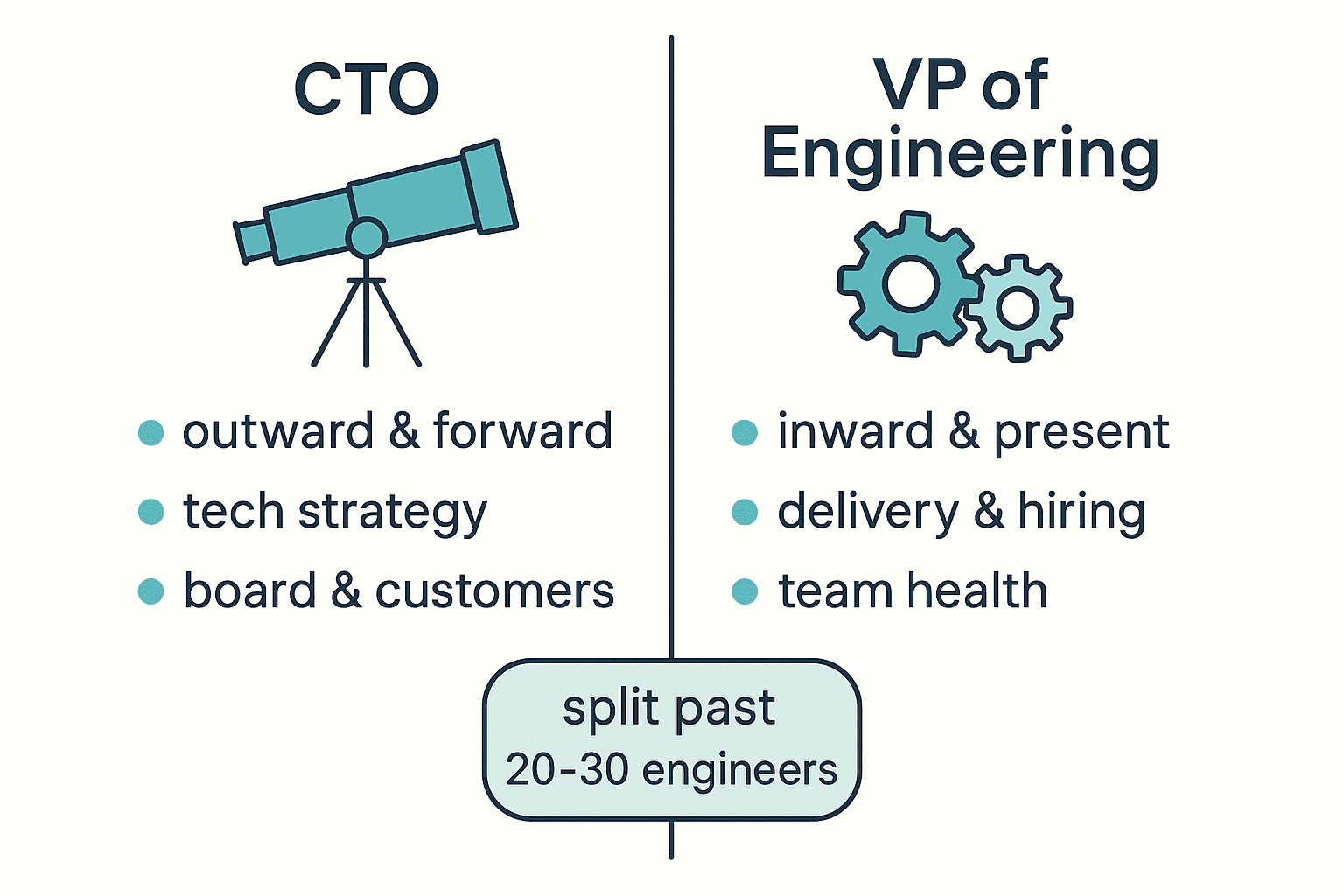
A CTO focuses outward and forward — technology strategy, product architecture, technical vision, and representing engineering to the board and customers.
A VP of Engineering focuses inward and present — delivery execution, team health, hiring, processes, and making sure the trains run on time.
Early-stage startups usually need one person wearing both hats. As you scale past 20–30 engineers, splitting these roles becomes essential. Many of the startups I work with initially need the VP of Engineering function more than the CTO function, but they hire for the wrong title because "CTO" sounds more important.
If delivery and team management are your pain points, you might actually need a VP of Engineering — or a fractional VP of Engineering — before you need a CTO.
How to Make the Right Hire
Once you've decided the timing is right, avoid these common pitfalls:
Don't hire for pedigree alone. A CTO from a 10,000-person company may be lost at your 15-person startup. Stage experience matters more than brand names on a resume.
Don't hire your best engineer into the role. Being a great individual contributor and being a great CTO require different skills. Your best engineer might hate managing people, setting budgets, and sitting in board meetings. Promote carefully.
Define the job before you write the job description. Do you need someone who writes code daily? Someone who manages managers? Someone who speaks at conferences? The answers shape entirely different candidate profiles.
Set a 90-day plan. Agree on concrete deliverables for the first three months. This protects both sides — the new CTO knows what success looks like, and you can evaluate fit before it's too late.
The Cost of Getting It Wrong
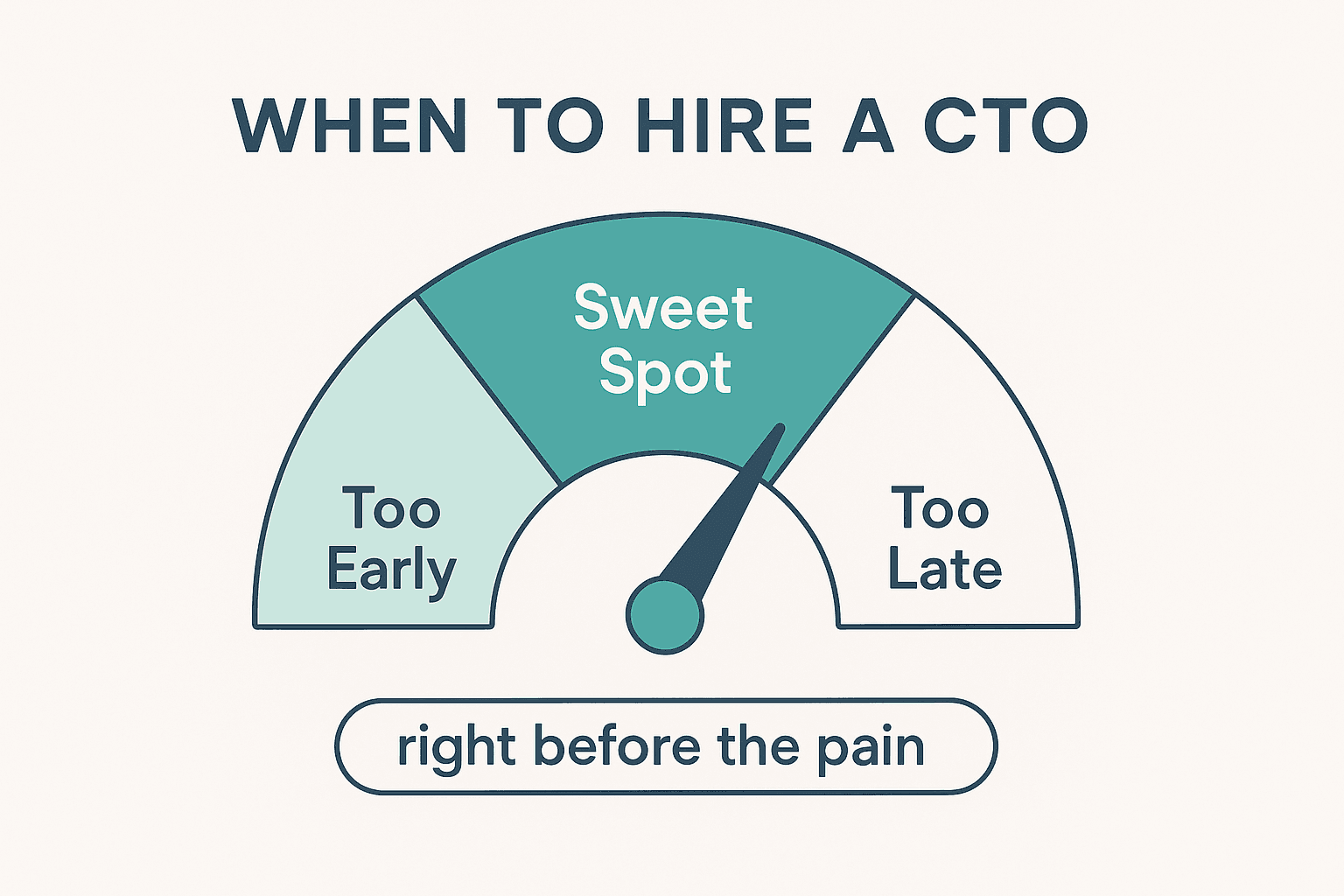
Hiring a CTO too early means you're paying executive compensation for work a senior engineer could do. Hiring too late means you're scrambling to fix architectural decisions that have already calcified, rebuilding a team that's lost trust in leadership, and explaining to your board why velocity cratered.
The sweet spot is usually right before you feel the pain acutely — when things are starting to strain but haven't broken yet. If you wait until they break, you're already six months behind.
What to Do Right Now
If you're reading this and recognising some of these signs, here's a simple framework:
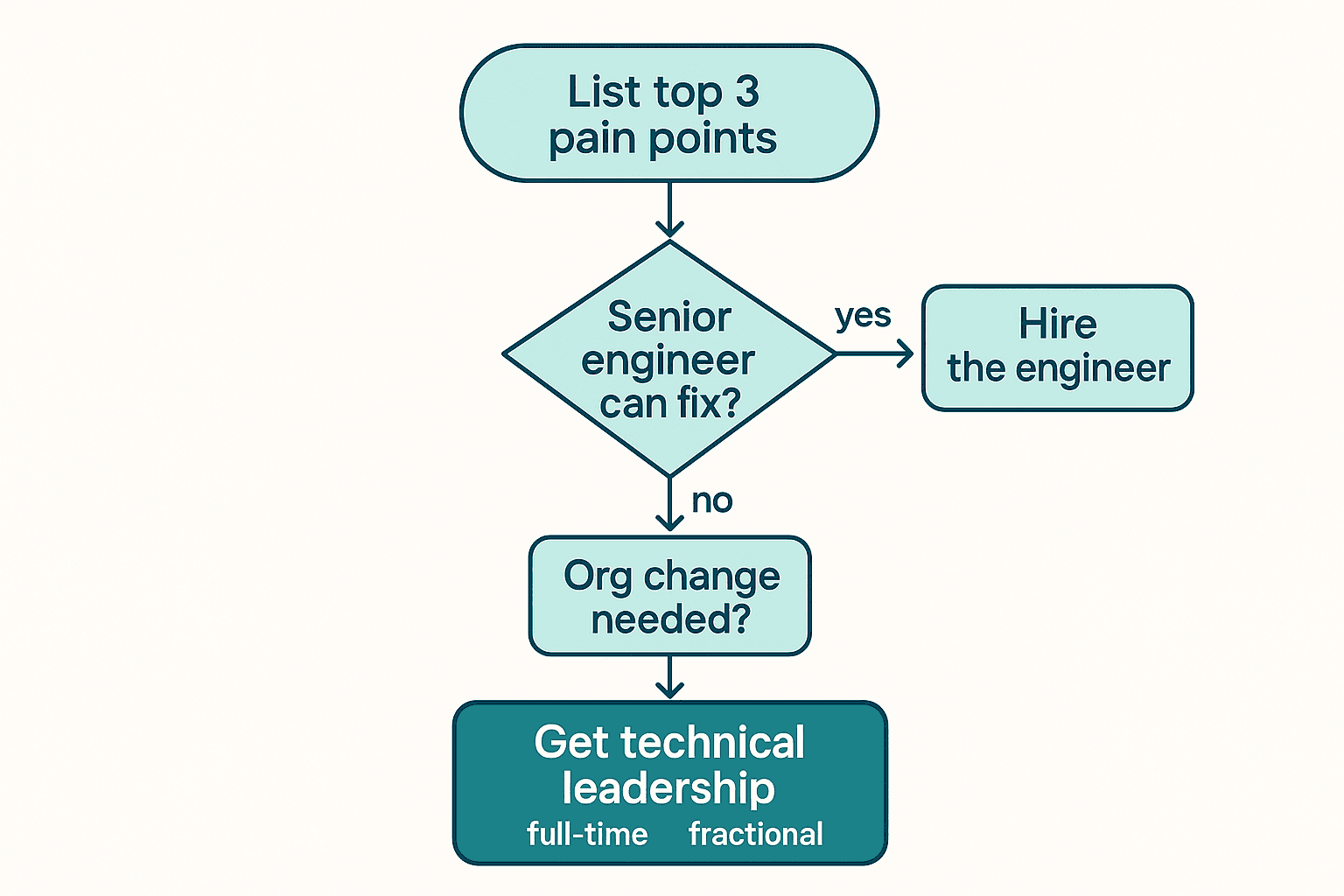
- List your top 3 technical pain points. Be specific. "Things are slow" doesn't count. "We can't deploy more than once a week because our test suite takes 4 hours" does.
- Ask: could a senior engineer fix these? If yes, you don't need a CTO yet. Hire the engineer.
- Ask: do these problems require organisational change, not just code changes? If yes, you need technical leadership.
- Decide: full-time or fractional? If you're pre-Series B with fewer than 20 engineers, a fractional engagement is almost always the smarter first step.
If you're unsure where you stand, I'm happy to talk it through. I've helped dozens of founders navigate this exact decision — sometimes the answer is "hire a CTO," sometimes it's "hire two senior engineers and revisit in six months." The right answer depends on your specific situation.
Hit like if you enjoyed this post!
Keep reading
Your First 90 Days as a Fractional CTO: A Practical Playbook
The first 90 days set the tone for the entire engagement. Move too fast and the team resists. Move too slow and you lose credibility. Here is the playbook I follow.
May 25, 2026Fractional CTOFractional CTO vs Full-Time CTO: Cost, Scope & When Each Makes Sense
Most founders pick between a fractional and full-time CTO based on cost. That's the wrong way to choose. Here is a clearer way to think about it.
May 25, 2026