When to Split Support From Engineering (Without Losing Context)
In a small company, support and engineering are the same thing. A customer hits a bug, the message lands in a shared channel, and the engineer who wrote the code fixes it that afternoon. Nobody calls this a "support function." It just happens. And it works far better than most people admit, because the person fixing the problem is the person who caused it, and they hear the customer's frustration directly.
Then you grow. The volume goes up. Engineers start dreading the support rotation. Someone senior says "we need to protect engineering's focus time," and they're not wrong. So you hire a support team, route the tickets to them, and put a queue between your engineers and your customers.
That queue is the most dangerous thing you will build at this stage.
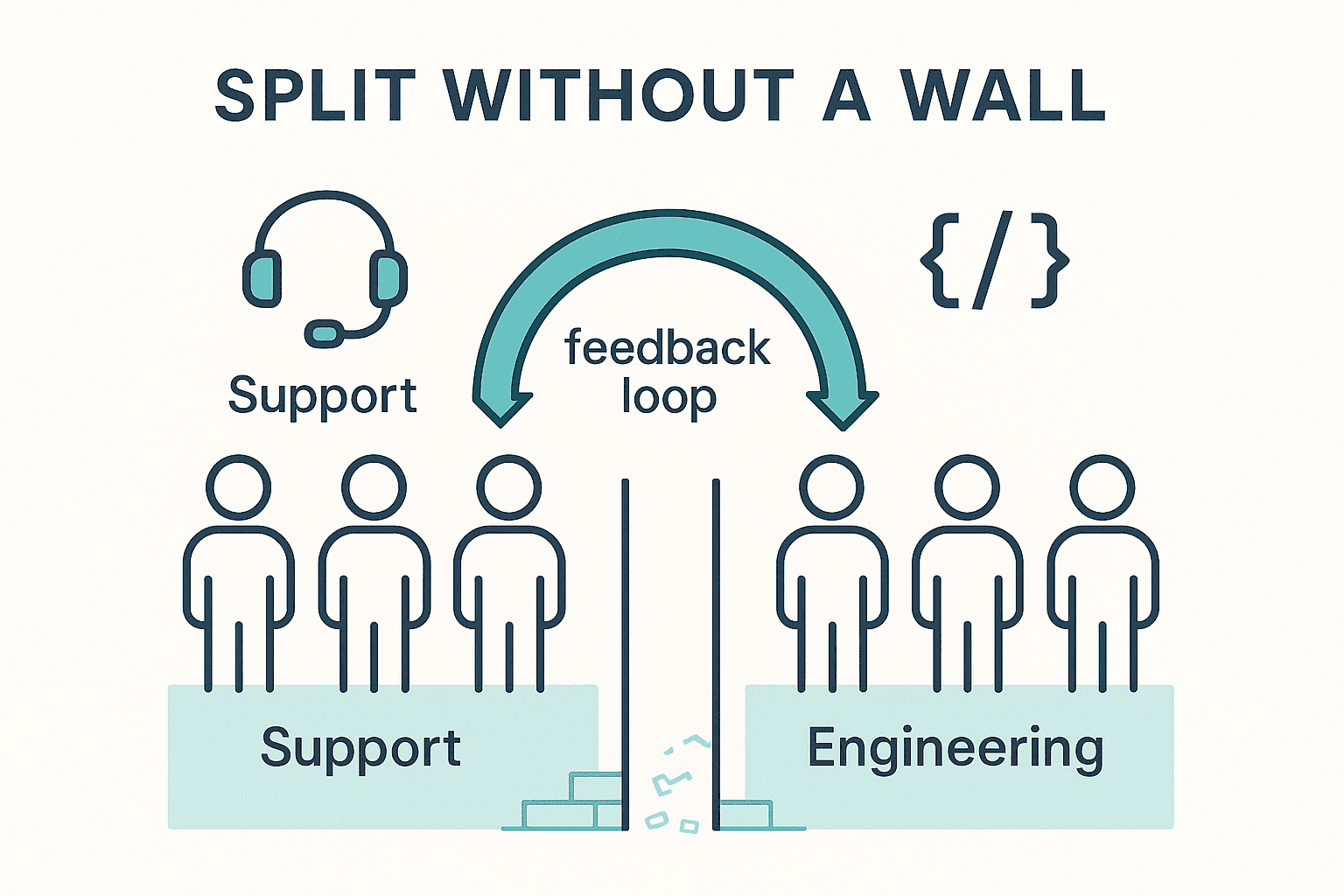
Done well, splitting support out of engineering buys you focus, faster response times, and people who are genuinely good at talking to customers. Done badly, it builds a wall. Engineers stop hearing from real users. Product decisions drift. Bugs that used to get fixed in an afternoon now sit in a backlog because nobody who can fix them ever feels the pain. This article is about how to make the split and keep the thing that mattered.
The warning signs it's time to split
You don't split because you hit a headcount number. You split because of symptoms. Here are the ones I actually watch for.
Engineers are context-switching themselves into the ground. When someone on the rota is getting pinged ten or fifteen times a day, their actual project work stops. You'll see it in velocity that drops every time a particular person is "on support." That's a tax, and at some point it's cheaper to hire a dedicated function than to keep paying it in senior engineering time.
Response time depends on who's awake. In the early days, fast responses are a happy accident of a small team in one timezone. Once you have real customers in three regions, "whoever sees it first" stops being a strategy. You need coverage, and coverage needs people whose job is coverage.
The same questions keep coming back. When 60% of your inbound is the same handful of "how do I" questions, you don't have an engineering problem, you have a support problem. Engineers are expensive people to answer the same onboarding question forty times. That work is real and valuable, but it isn't engineering.
Nobody owns the customer's experience of a problem. An engineer fixes the bug and moves on. Did anyone tell the customer? Did anyone check it actually resolved their issue? In a shared model this falls through the cracks constantly, because engineers optimise for "code is correct," not "human is happy."
If you're nodding at three of these, it's time. Usually this lands somewhere between 20 and 150 engineers. The exact number doesn't matter. The symptoms do.
What support owns versus what engineering owns
The split fails when the line is fuzzy. So draw it explicitly, write it down, and make sure both sides agree on it before you route a single ticket.
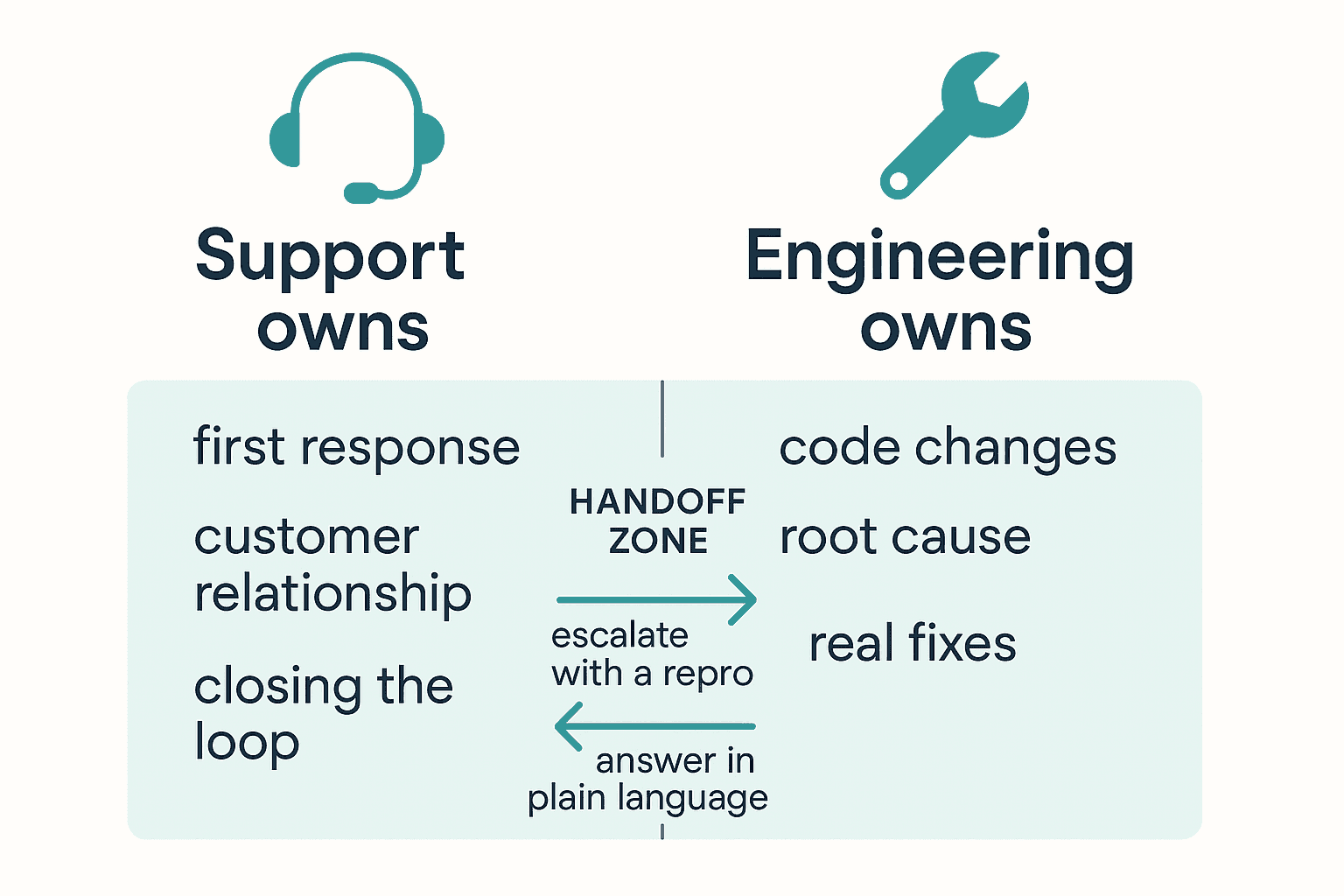
Here's the division that has worked for me.
Support owns the customer relationship and the first response. Every inbound message hits support first. They trie, they reproduce where they can, they handle the long tail of "how do I" and "is this expected" questions, and they own the communication back to the customer from start to finish. Even when engineering does the actual fix, support owns telling the customer it's fixed and confirming they're happy. The customer's experience of the problem is support's job, end to end.
Engineering owns the code and the root cause. When something is genuinely broken, when it needs a code change, a data fix, or a real investigation into why the system behaved that way, that's engineering. Support should never be editing production data or shipping hotfixes. That's how you get a second outage on top of the first.
The handoff between them is where all the value or all the pain lives. Two rules make it work.
First, support escalates with a reproduction, not just a complaint. A good escalation says: here's what the customer did, here's what happened, here's what should have happened, here are the logs and the account ID, and here's how often it's happening. That turns a vague "customer is angry" into a ticket an engineer can actually act on. This is a skill, and you have to train for it.
Second, engineering owes support a real answer, not a status code. "Closed as won't fix" with no explanation poisons the relationship fast. If engineering won't fix something, support needs to know why, in plain language, so they can carry that back to the customer. The handoff goes both ways.
The real risk: support becomes a wall
Now the part everyone gets wrong.
The whole point of the split was to protect engineering's focus. But "protect" quietly turns into "insulate," and insulated engineers stop hearing from customers entirely. Six months later you have an engineering team building features nobody asked for, fixing bugs in priority order set by a JIRA field instead of by actual customer pain, and a support team absorbing all the frustration with no power to fix anything.
The support team becomes a wall. Customer signal goes in. It never comes out the other side to the people who can act on it.
You can see this happening before it's fully formed. The tell is when an engineer says, in a planning meeting, "do customers actually care about this?" and nobody in the room knows. In a healthy org someone always knows, because someone talked to a customer that week. When that knowledge disappears from engineering, the wall is already up.
So the split is only half the job. The other half is deliberately rebuilding the feedback loop you just cut. This doesn't happen on its own. You have to engineer it.
How to keep engineers connected to customers after the split
Here's the operating model I put in place. None of it is exotic. All of it is the kind of thing that quietly stops happening unless someone makes it a standing commitment.
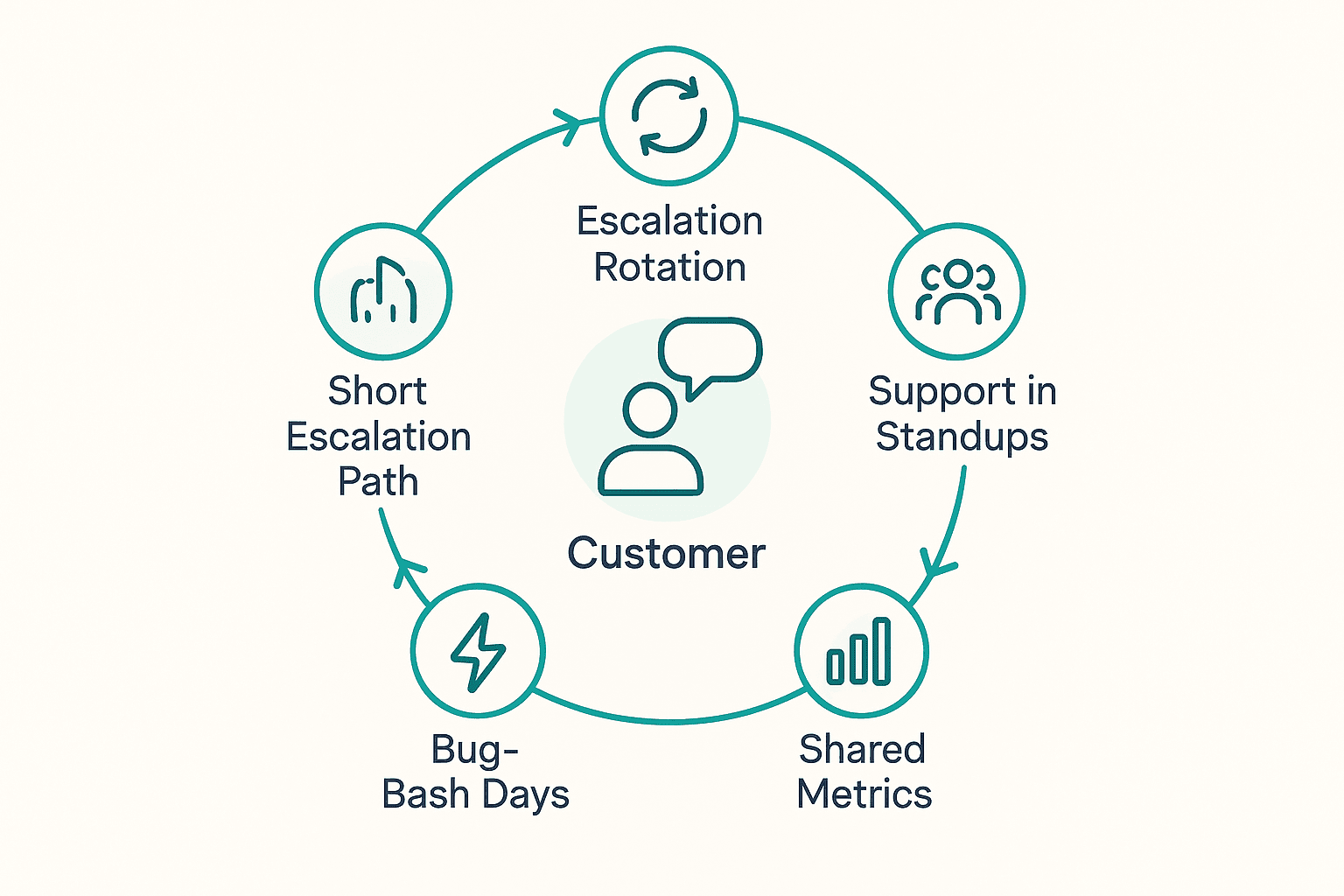
Keep a small engineering escalation rotation
Don't put a wall up and walk away. Keep one engineer per week on an explicit support-facing rotation. Not buried in tickets like before, but as the named person support escalates to and pairs with on the hard ones. This person sits closer to the customer for a week, sees the patterns, and then goes back to their team and says "we keep getting hit on X." That single sentence in a standup is worth more than any dashboard.
Rotate it. Everyone takes a turn, including your seniors and your tech leads. The moment it becomes "the junior's job" you've lost the point.
Put support in engineering's standups
Have a support lead, or the escalation engineer, drop into the relevant team standups. Two minutes. "Here's what we're seeing this week, here's what's spiking, here's the one that's making customers angry." It costs almost nothing and it keeps customer reality physically present in the room where work gets prioritised.
Share metrics, not just within each team but across the wall
Both teams should look at the same numbers. Top recurring issues. Escalation volume. Time-to-resolution on real bugs, not just first-response time. If support is measured only on ticket-closing speed and engineering only on shipping, their incentives drift apart and the wall thickens. Give them a shared scoreboard so they're solving the same problem together. The best shared metric I've used is simply: which five issues are generating the most support load right now, and who owns reducing each one.
Run bug-bash days
Once a sprint, or once a month if you must, take the top recurring support issues and have engineering spend a day killing them. Not feature work. Not the roadmap. Just the papercuts that support has been absorbing for weeks. This does two things. It clears the long tail that never wins a prioritisation fight, and it forces engineers to sit with the actual texture of what customers struggle with. Engineers come out of a good bug-bash day saying "I had no idea this was so annoying." That's the feedback loop working.
Make the escalation path short and human
The number of hops between an angry customer and the engineer who can help should be small and obvious. One escalation channel. A named owner. A response expectation in hours, not days, for the genuinely broken things. If escalating feels like throwing a message into a void, support stops doing it and starts working around engineering, and now you've got two broken processes instead of one.
A note on SRE, because it's coming next
If you're splitting support out now, the same pressure is about to hit reliability. The on-call burden that engineering carries informally will, at some point, need its own structure too. The principle is identical: you can specialise the function, but you must not sever the feedback. An SRE team that owns reliability in isolation, with product engineers who never feel a page, produces exactly the same wall in a different shape. Whoever builds the system has to stay close to how it fails in production. Keep that in mind as you grow, because the org-design mistake repeats.
The bottom line
Splitting support out of engineering is the right move at scale. The mistake isn't the split. The mistake is treating it as a clean handoff and assuming the feedback loop survives on its own. It doesn't.
So split the function, but keep the wire. Rotate engineers through the customer's reality. Put support in the room where work gets prioritised. Share one scoreboard. Spend real engineering time killing the papercuts support has been absorbing. The teams should specialise without becoming strangers.
If you do that, you get the focus you split for and you keep the thing that made you good when you were small: engineers who actually know what their customers are going through. Lose that, and you'll be the company shipping a beautiful roadmap to people quietly leaving out the back door.
Hit like if you enjoyed this post!
Keep reading
Error Budgets Are a Management Tool, Not an Engineering One
Most error budgets die quietly because engineers introduced them with no authority behind them. The number only matters when it changes what leadership does. Here is how to wire budget burn into roadmap decisions, exec reviews, and feature-freeze conversations so it actually has teeth.
June 09, 2026Support & SRESRE Org Design: Centralized, Embedded, or Platform?
Centralized, embedded, or platform SRE? Each model solves a different problem and breaks in a different way. Here is how to pick one, and how to migrate when you outgrow it.
June 05, 2026