CTO vs VP of Engineering: Two Roles, One Mission, Very Different Jobs
If you've spent any time in tech leadership, you've probably noticed that the line between a CTO and a VP of Engineering can feel blurry. Some companies use the titles interchangeably. Some startups have a CTO doing what is essentially a VP of Engineering's job, and vice versa. And yet, when an organization gets the distinction right, the engineering org tends to run like a well-tuned machine. When it gets it wrong, bottlenecks, confusion, and misaligned priorities follow.
I've seen this dynamic play out across several companies, and I think the confusion often comes from the fact that both roles care deeply about technology and both carry significant leadership weight. But the nature of that leadership is fundamentally different.
The CTO: Vision, Strategy, and the "What" and "Why"
The CTO is a strategic role. This is the person responsible for answering questions like: Where should our technology be in three to five years? What emerging technologies should we bet on? How does our technical strategy align with business goals?
A good CTO spends their time looking outward: understanding the market, studying competitors, evaluating new paradigms (whether that's AI, edge computing, or a new database architecture), and translating all of that into a coherent technical vision for the company. They work closely with the CEO, the board, and other C-level executives to ensure that technology decisions support the overall business strategy.
In practice, the CTO is often the person who sets the long-term technical direction and architecture principles, evaluates build-vs-buy decisions at the strategic level, represents the company externally at conferences and with partners, manages the patent portfolio and IP strategy, engages with investors and the board on technology matters, and leads research initiatives and proof-of-concept explorations.
The CTO's direct reports tend to be a relatively small group: principal architects, research engineers, and sometimes the VP of Engineering themselves. They are not typically managing dozens of engineers day-to-day.
The VP of Engineering: Execution, People, and the "How" and "When"
The VP of Engineering is an execution-focused leader. Their job is to take the vision and turn it into reality. Reliably, predictably, and at scale.
If the CTO decides the company needs to migrate to a microservices architecture, the VP of Engineering figures out how to do it without breaking production, how to staff the effort, how to sequence the work across teams, and how to keep morale high while the team is deep in a multi-quarter migration.
This role is deeply people-oriented. The VP of Engineering is typically responsible for building and scaling engineering teams (hiring, onboarding, retention), managing engineering managers and directors, defining and improving engineering processes like CI/CD pipelines and code review practices, translating product and business roadmaps into technical execution plans, owning delivery and making sure features ship on time with quality, managing the engineering budget, and building engineering culture.
The VP of Engineering's success is measured by the output and health of the engineering organization. Are teams shipping? Is quality high? Is attrition low? Are engineers growing in their careers?
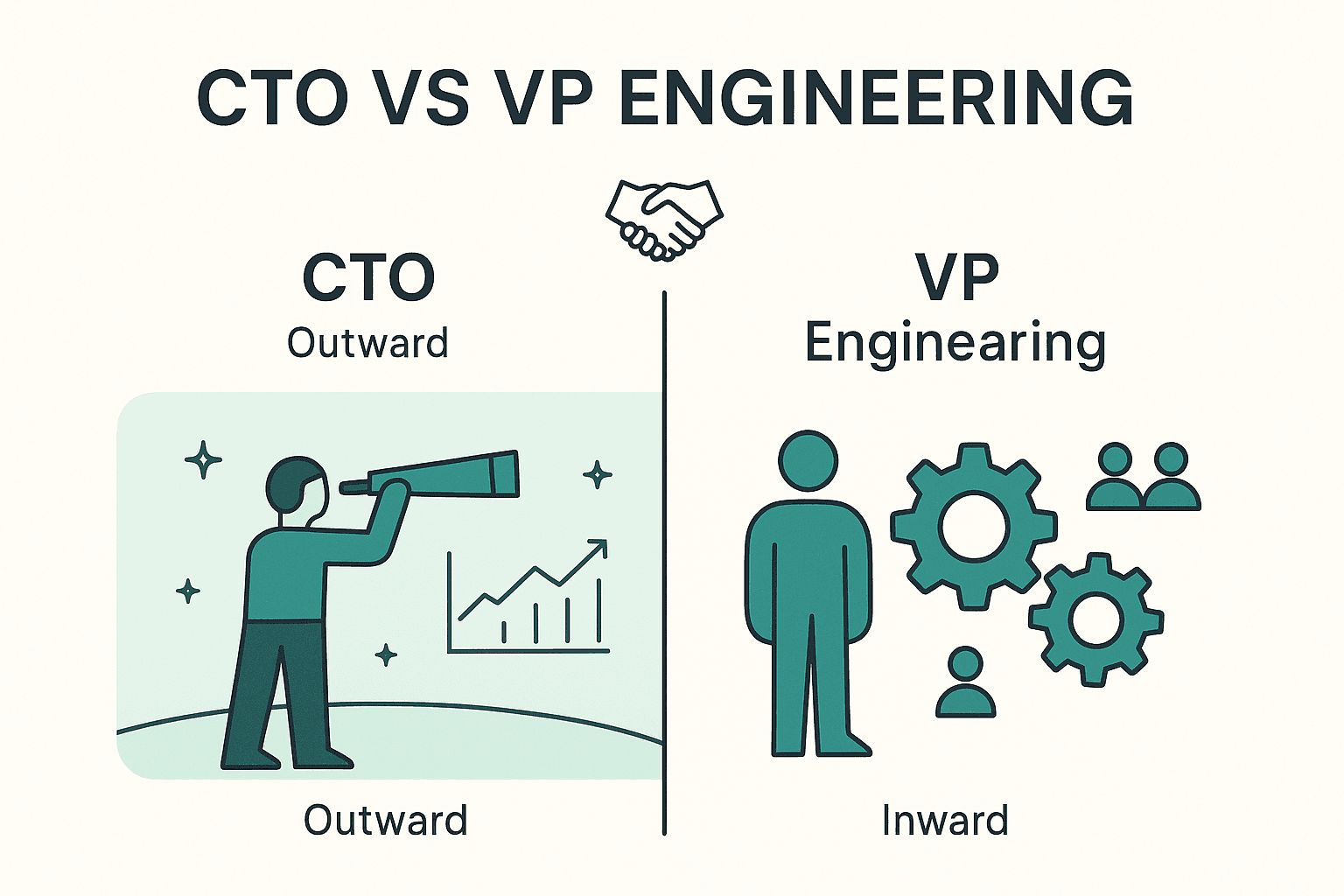
The Core Distinction: Outward vs Inward
Here is the simplest way I think about it:
The CTO looks outward. They focus on the market, the technology landscape, and the company's strategic positioning. Their primary audience is the executive team, the board, and external stakeholders.
The VP of Engineering looks inward. They focus on the engineering organization itself: its people, its processes, its output. Their primary audience is the engineering team and cross-functional partners like Product and Design.
This doesn't mean the CTO never talks to engineers or the VP of Engineering never talks to the CEO. Both do. But the center of gravity for each role is different.
When Do You Need Both?
In early-stage startups, these roles are almost always combined. A technical co-founder typically serves as CTO and handles everything from writing code to hiring the first engineers to setting technical direction. That's just how it works when you're small.
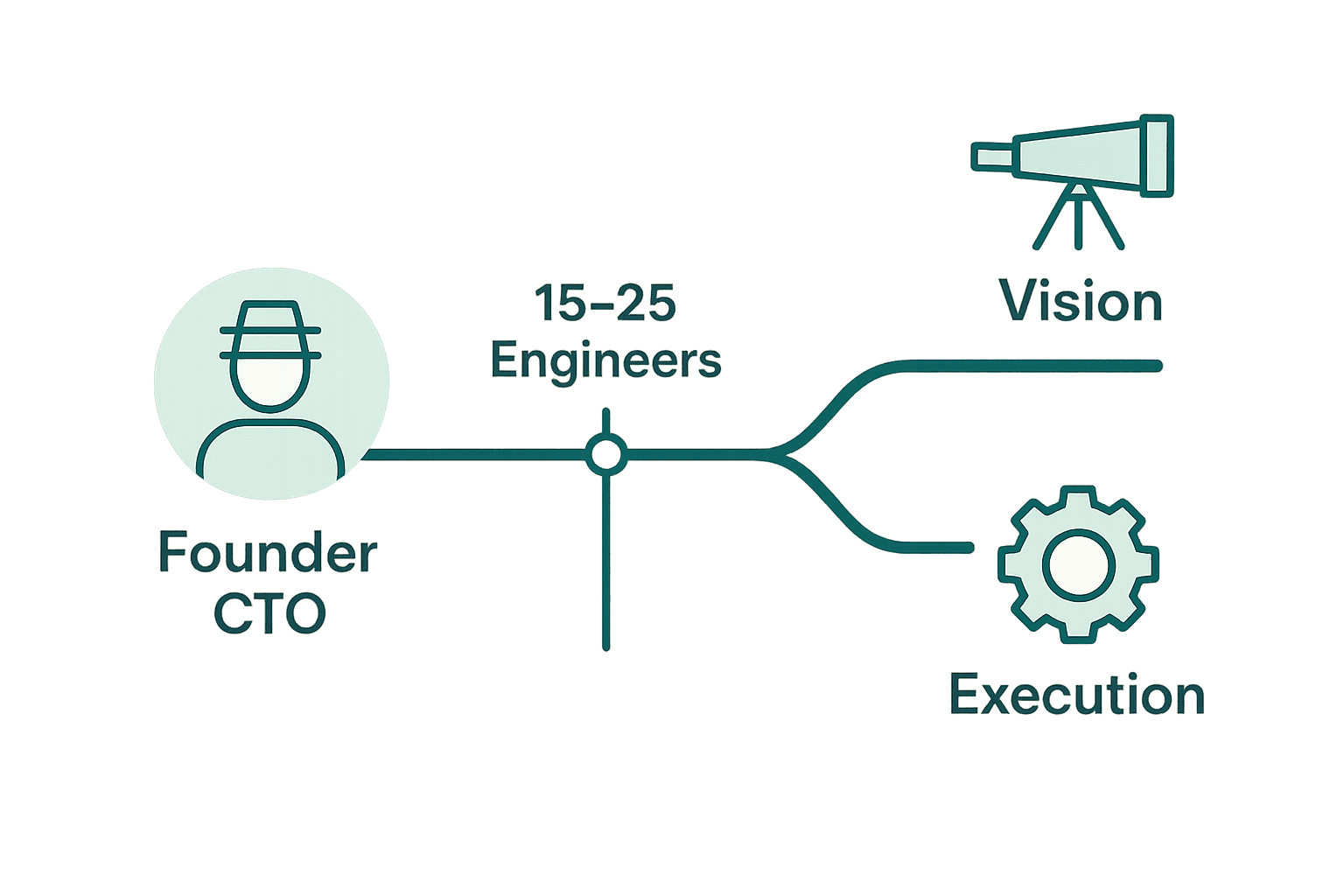
The need for a dedicated VP of Engineering usually emerges when the engineering team grows to roughly 15 to 25 people. At that point, the technical co-founder (now CTO) starts to feel the pull in two directions: they want to focus on product innovation and technical strategy, but they're spending most of their time on hiring, performance reviews, process improvements, and cross-team coordination. Something has to give.
This is the inflection point. Bringing in a VP of Engineering allows the CTO to return to what they do best (vision and strategy) while the VP of Engineering takes ownership of the machine that turns that vision into working software.
My Take: The Fun Shifts as the Company Grows
Here's something I don't see discussed enough. The appeal of these roles changes dramatically depending on the stage of the company.
At a startup, the VP of Engineering role is where the action is. You're building everything from scratch. Hiring the first ten engineers, setting up the CI/CD pipeline for the first time, choosing the tech stack, establishing code review culture, figuring out how to ship fast without accumulating crippling tech debt. Every week brings a new problem you've never solved before. You're building the engine while the plane is taking off. That's exciting.
The CTO role at a startup, by contrast, can feel a bit abstract. There's not much "vision setting" to do when you have five engineers and one product. The strategy is obvious: build the thing, ship it, don't run out of money. A startup CTO who spends too much time on long-term architecture planning instead of unblocking their team is probably hurting more than helping.
But at a mature company, this flips completely. The VP of Engineering role becomes more about maintaining and optimizing what already exists. Process improvements get incremental. The org chart is mostly set. You're managing managers who manage managers. It's important work, absolutely, but it can feel like you're keeping a machine running rather than building one.
The CTO role at a mature company, though? That's where it gets really interesting. You have real resources to invest in R&D. You're evaluating whether to bet on a new technology that could reshape your entire product. You're in the room with the board making decisions that will define the company's direction for the next five years. You're thinking about acquisitions, platform plays, and competitive moats. The strategic canvas is much bigger, and the decisions carry real weight.
So if someone asked me: would you rather be a VP of Engineering or a CTO? My honest answer is that it depends entirely on the company stage. Give me the VP role at a 30-person startup. Give me the CTO role at a 500-person company. That's where each role is the most rewarding.
Where Things Go Wrong
I've seen a few common failure modes.
The CTO who won't let go. A founding CTO who insists on staying involved in every technical decision, every architecture review, every hiring call, even after a VP of Engineering is hired. This creates confusion about who owns what and often demoralizes the VP of Engineering.
The VP of Engineering who has no counterpart. Some companies hire a VP of Engineering but don't have a strong CTO (or the CTO is purely a figurehead). The VP of Engineering ends up doing both jobs, and the strategic, forward-looking work suffers because operational demands always feel more urgent.
Misaligned expectations. The company hires a "CTO" but expects them to manage teams and run sprints. Or they hire a "VP of Engineering" but expect them to be the external face of the technology org. Title and expectations need to match.
No clear reporting structure. Does the VP of Engineering report to the CTO or directly to the CEO? Both models exist, and both can work, but it needs to be explicit. Ambiguity here leads to power struggles and duplicated effort.
A Quick Comparison
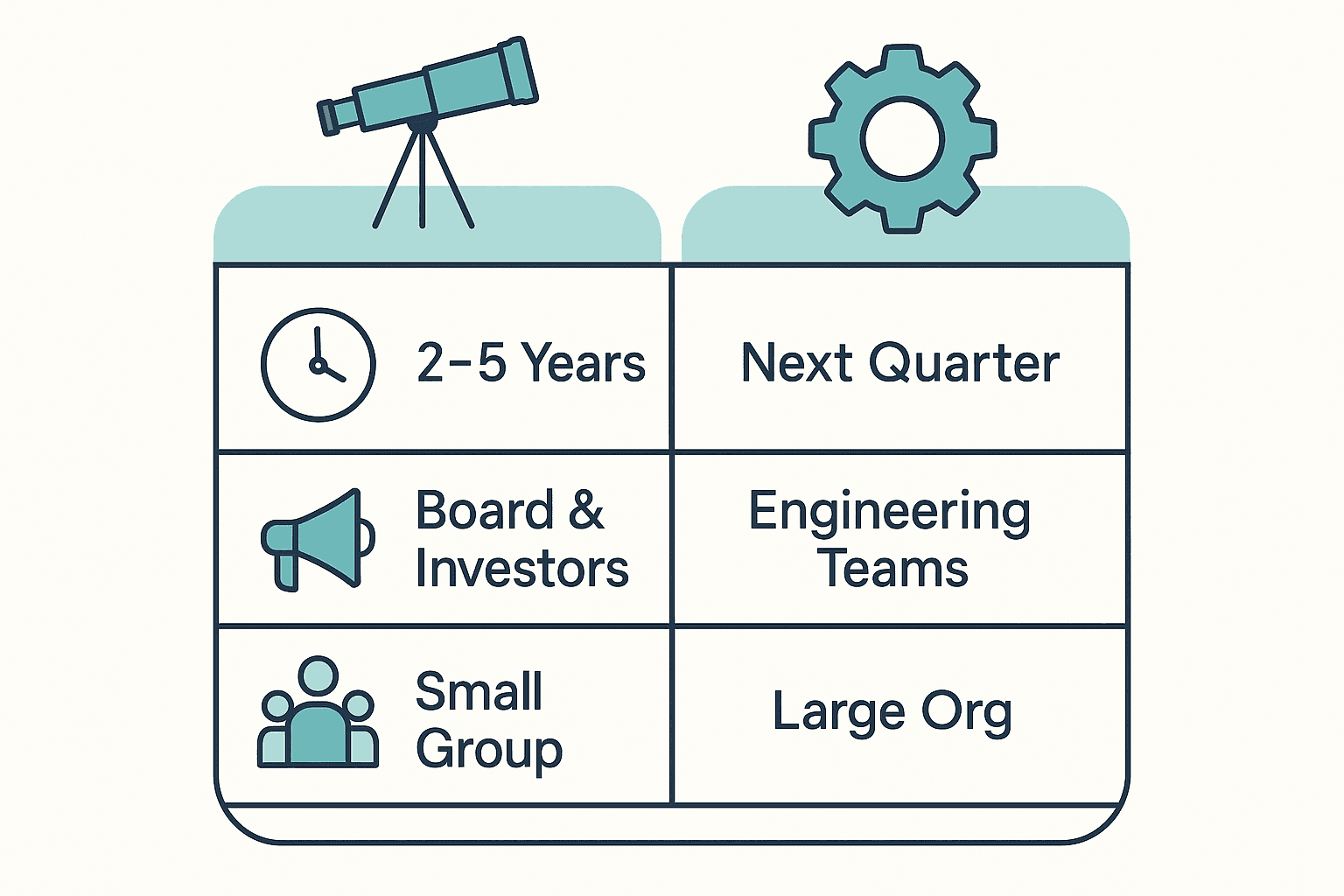
| Dimension | CTO | VP of Engineering |
|---|---|---|
| Primary focus | Technical vision and strategy | Engineering execution and delivery |
| Time horizon | 2-5 years out | Current quarter to next year |
| Key audience | Board, CEO, external stakeholders | Engineering teams, Product, Design |
| People management | Small group (architects, research) | Large org (engineers, managers, directors) |
| Hiring involvement | Key strategic hires | Day-to-day recruiting and team building |
| External presence | Conferences, partners, investors | Mostly internal |
| Success metrics | Technical differentiation, innovation | Delivery velocity, quality, team health |
| Most exciting at | Mature companies with real scale | Early-stage startups building from zero |
The Best Partnerships
The most effective engineering organizations I've worked with have a CTO and VP of Engineering who operate as genuine partners. The CTO brings the "what" and "why," and the VP of Engineering brings the "how" and "when." They challenge each other, align regularly, and stay out of each other's lanes.
When this partnership works well, you get the best of both worlds: a technically ambitious company that can actually execute. When it doesn't, you get either a team that builds the wrong things brilliantly, or one that has a great vision sitting on a shelf.
Choosing Your Path
If you're an engineering leader thinking about where you want to go, the choice between CTO and VP of Engineering often comes down to what energizes you.
Do you love diving into new technologies, thinking about where the industry is heading, and connecting technical decisions to business outcomes? The CTO path might be for you.
Do you love building teams, mentoring leaders, removing obstacles, and watching a group of engineers grow into a high-performing organization? You might be a natural VP of Engineering.
And remember, the stage of the company matters just as much as the title. Pick the role that matches not just your skills, but where the company is in its journey.
What has your experience been with these roles? Have you seen them work well together, or struggle? I'd love to hear your perspective.
Hit like if you enjoyed this post!
Keep reading
Engineering Process Audit: How to Assess Your Team's Health
An engineering process audit is one of the highest-leverage things a leader can do. Here is a practical framework for running one, plus what good and bad actually look like.
May 25, 2026Engineering LeadershipHow to Scale Your Engineering Team from 10 to 100
Most engineering leaders hit a wall somewhere between 10 and 30 people. Here's what actually works — from team topology to management promotion to staying technical without burning out.
March 06, 2026